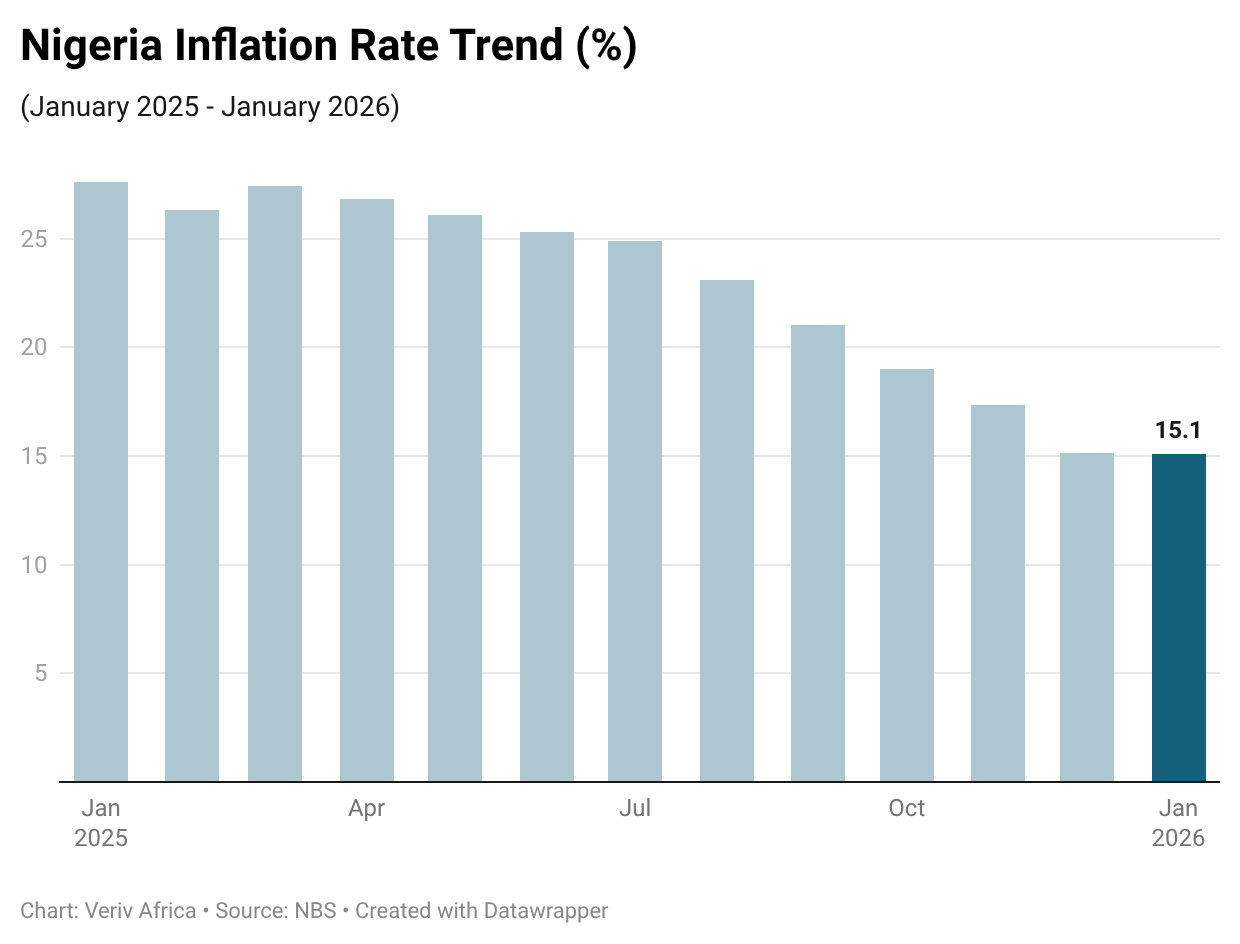
Nigeria’s headline inflation eased to 15.10% in January 2026, down from 15.15% at the close of 2025, marking a remarkable ten-month decline and the lowest level recorded since November 2020. The economy reached another feat in the same month: food inflation cooled to its first single-digit level in over a decade, settling at 8.89%. These milestones are largely credited to a resurgent naira and a significant boost in domestic food production.
Nigeria’s inflation has hit a momentum of steady decline, and forecasts assume even lower levels in the coming year. If this stability is sustained, 2026 could represent a transformative year, offering stronger purchasing power and improved living standards for the average Nigerian. The critical question remains: how realistic are these expectations?
Nigeria’s Inflation History
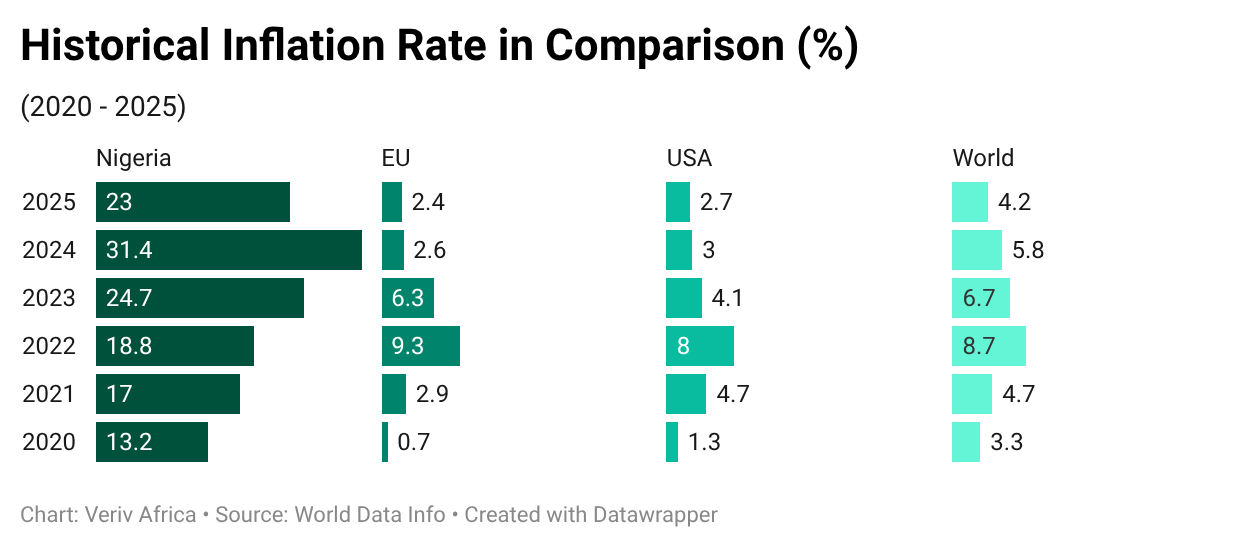
While price levels are currently stabilising, Nigeria’s economic history tells a much more volatile story. In Nigeria’s 65 years of independence, the inflation rate has ranged from -3.7% to 72.8%, averaging 16.6% annually. To put that into perspective: an item that cost ₦100 in 1960 would cost approximately ₦1.36 million today. Looking back at the last five years, the trend was largely upward. Starting at 13.25% in 2020, inflation climbed to 17% in 2021, and continued its ascent till 2024, with the rate hitting 18.8%, 24.7%, and 31.4% in 2022, 2023, and 2024, respectively. This relentless climb, fueled by the removal of fuel subsidies, pandemic aftershocks, and forex volatility, significantly weakened the nation’s purchasing power. However, 2025 broke the inflation curse. The easing seen last year provided a glimmer of hope for improved living standards. The decline is expected to continue through 2026.
Nigeria’s Inflation Future: 2026 Projections
To map out where we are headed, we turn to Veriv Africa’s Nigeria Macroeconomic Outlook for 2026 which uses a macroeconometric model to project three possible paths for Nigeria’s economy based on different domestic and global conditions: best-case scenario, base-case scenario, and worst-case scenario.
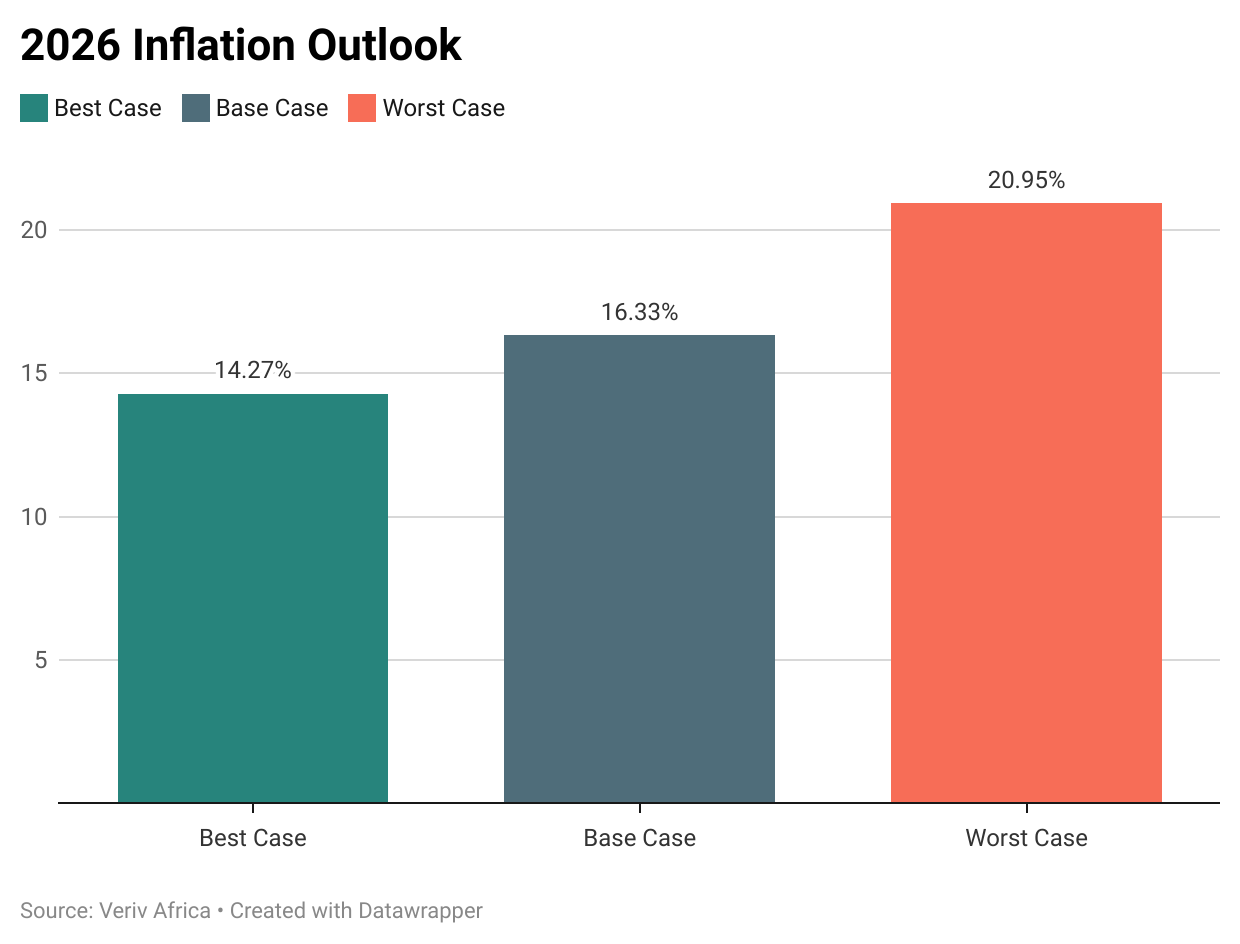
Assuming the economy remains the same with no major shocks, the base case scenario forecasts inflation at 16.33%. This assumes a steady money supply, an MPR of 27%, and an exchange rate hovering between ₦1,460 and ₦1,465 per US dollar. Defying the models, January’s 15.10% rate has already outperformed this projection, surpassing early expectations. However, it is still early days, and it remains to be seen if this momentum can be sustained.
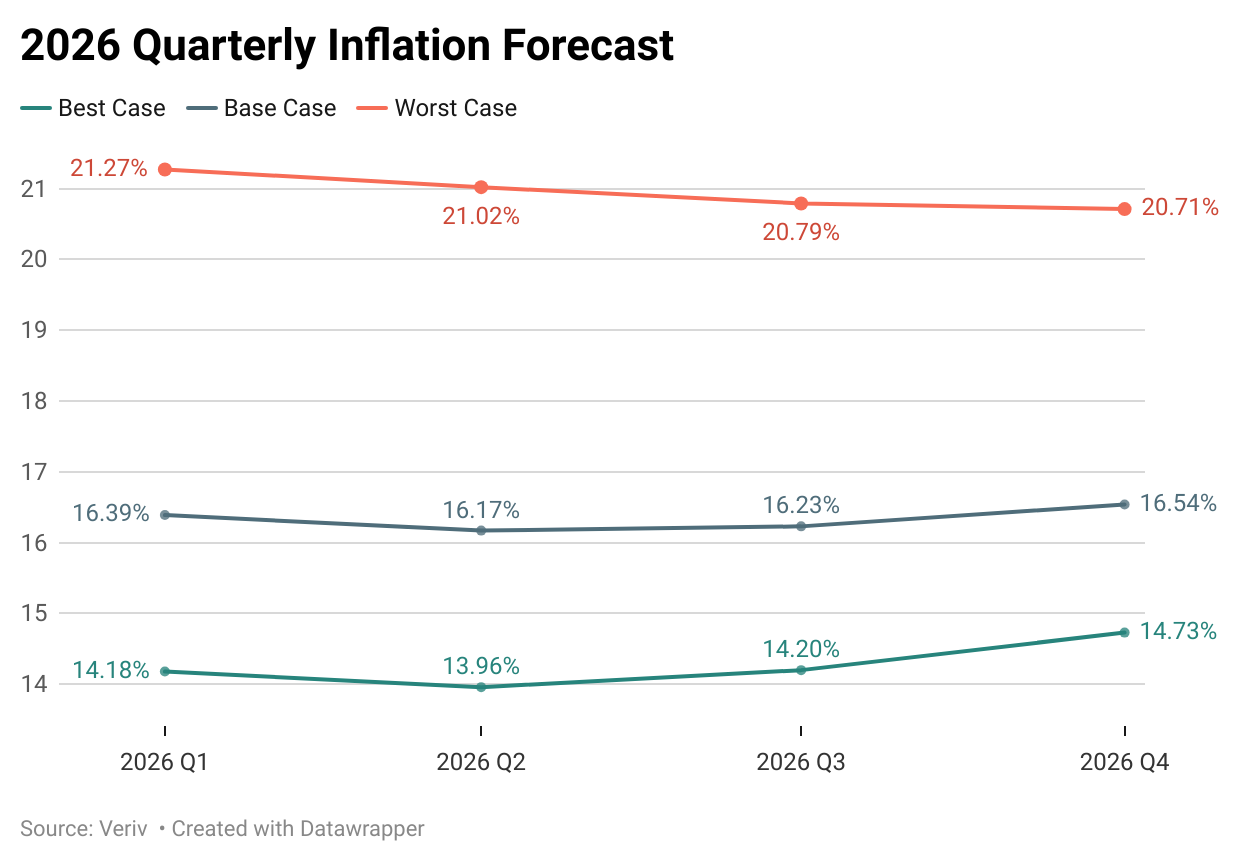
Early indicators suggest Nigeria is trending toward the best-case scenario, which assumes inflation easing to 14.27% by year-end. This path relies on an MPR averaging 24.5% in 2026, a stronger naira at ₦1,300 per US dollar, and GDP growth hitting 4.46%. Despite the optimism, a reality check is necessary. The best-case quarterly forecast targets 14.18% for Q1 2026. With January sitting at 15.1%, a significant gap remains. To hit the quarterly assumption, we would need to see an aggressive decline in March.
How Does This Affect You?
The numbers and charts show a steady decline since early 2025, and our best-case scenario predicts further relief for 2026. Yet, beyond the data, a fundamental question remains: how does this decline translate to improved living standards for Nigerians? What do these numbers really mean for us?
The downward inflation trend does not automatically translate to lower market prices. At 15.10%, inflation is still quite high, but its easing impact is felt in a different way: price predictability. While prices of goods and services may not necessarily decrease, the speed at which they flare up is finally slowing down.
Take Mrs. Tomike, for example. As a mother responsible for restocking her family’s pantry every fortnight, she has spent years battling the inflation curse on a static income. She used to dread her weekend market trips because no budget was ever enough to outrun the next hike. A cup of egusi was never the same price twice; it always seemed to add a few hundred naira between trips. The prices just never stopped going up.
However, in Mrs. Tomike’s recent trips, she noticed something unusual: the prices had not changed since her last visit. For the first time in years, her budget actually covered everything on her list. This is called price predictability. Inflation has eased enough to stabilise the market and reduce sudden hikes. It does not mean low prices yet, but it means the cost of living has stopped climbing exponentially, allowing Nigerians to finally breathe and plan. For investors, the easing inflation trend signals a critical reduction in macroeconomic volatility, restoring confidence in the economy and ultimately leading to increased investments in various sectors.
Conclusion
Nigeria’s path toward an optimistic inflation future is promising, but it is not guaranteed. Achieving the best-case assumption hinges heavily on sustained oil production, exchange rate stability, and mitigating climate and security shocks. If oil prices dip or domestic oil production falls, the resulting pressure on the naira would likely reignite inflationary trends. Furthermore, the persistent threat of insecurity to food-producing states remains a huge obstacle to domestic food production. The path is clear, but not without hurdles. Addressing these challenges is essential if the economy is to maintain the easing momentum. With stable policy execution, 2026 will be a year of dynamic growth. Nigerians like Mrs. Tomike may finally experience economic relief, and investors’ confidence will increase.
References
Inflation rates in Nigeria. (2026, February). World Data Info.
https://www.worlddata.info/africa/nigeria/inflation-rates.php#google_vignette
Nigeria Inflation Rate. (2025). Trading Economics.
https://tradingeconomics.com/nigeria/inflation-cpi
Veriv Africa. (2025). Nigeria Macroeconomic Outlook 2026.
https://www.verivafrica.com/2026outlook